
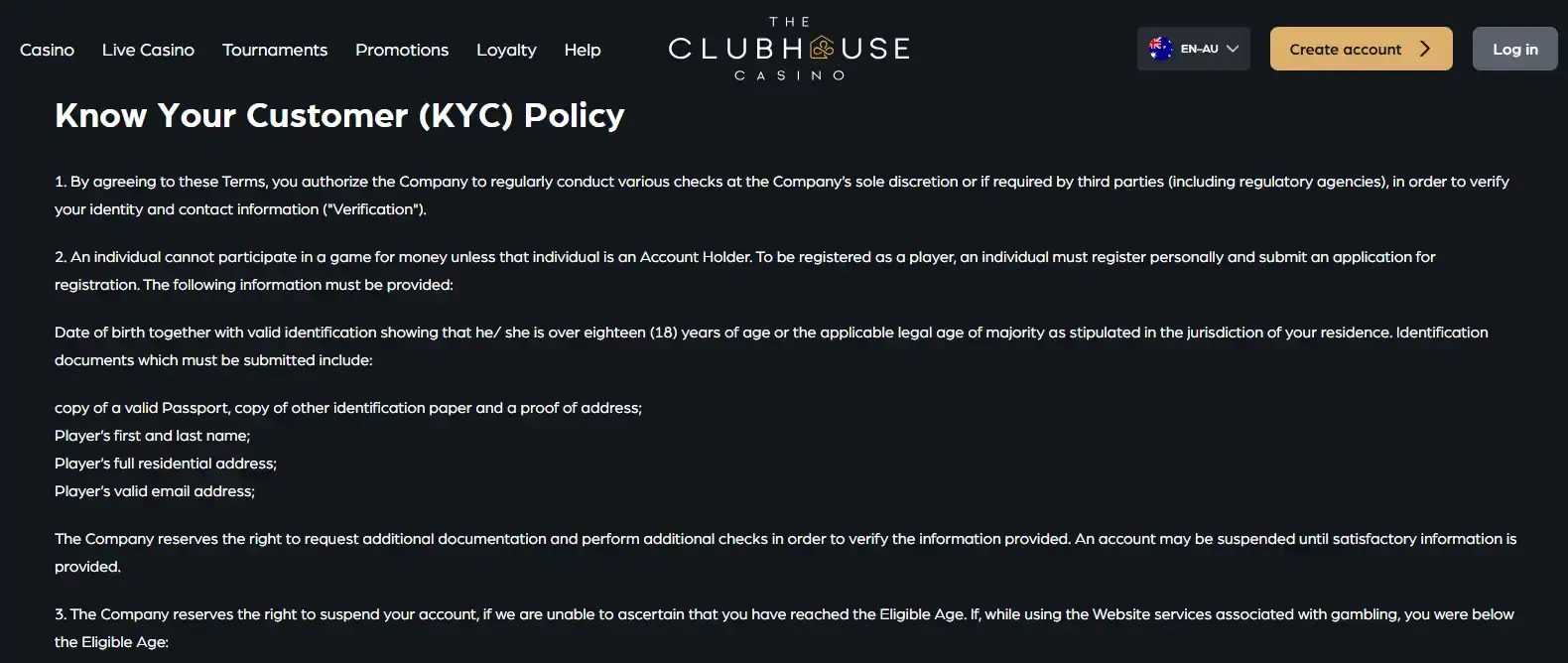
What the current official KYC policy requires
The current AU policy starts with identity and contact verification. It says an individual must be an account holder to participate for money and links registration to age and identity information. For documents, the policy identifies a valid passport or other identification paper together with proof of address. It also reserves the right to request additional documentation and conduct additional checks.
The current AU terms provide a closely aligned version of the same rule. They identify government-issued photo identification and proof of current address as core evidence and allow further information or documentation when verification requires it. Because document requirements are a high-risk detail that can change, this page uses the wording confirmed in the official policy and terms in the current official policy and terms rather than copying a fixed checklist from an affiliate review.
| KYC element | Current official position | Practical meaning |
|---|---|---|
| Identity | Valid identification is required when requested; the policy specifically names a valid passport or other identification paper. | Use current identity evidence that matches the account holder. |
| Address | Proof of address is part of the current policy. | The address evidence should correspond with the account information. |
| Additional checks | The operator reserves the right to request additional documentation or perform additional checks. | Do not assume the first documents submitted will always be the final request. |
| Review window | Consideration can take up to 30 working days after all requested documents have been supplied. | The clock described in the policy depends on the requested document set being complete. |
Why KYC matters to withdrawals
The most important operational consequence is that a withdrawal can remain pending while required verification is incomplete. That is why KYC should not be treated as a separate compliance topic that has no effect on cashout. Account identity, the requested evidence and the withdrawal review are connected parts of the same process.
If your immediate question is about minimums, weekly or monthly limits, processing after approval, or payout routing, use the cashout guide. That page covers the withdrawal rules. This page covers the verification stage that can occur before a withdrawal reaches the operator-processing and payment-delivery stages.
The separation helps with timing expectations. A published operator processing target for an approved withdrawal does not erase the time needed to complete KYC first. If verification is still open, the withdrawal can remain pending before the later payout stages begin.
How the account record connects to the documents
The KYC policy ties verification back to the information supplied during registration. It refers to date of birth, identification, name, residential address and email as account-holder information and allows the operator to check whether the information provided is satisfactory. The current account rules also describe registration as personal and limit each individual to one personal account.
The practical lesson is consistency. The name and address in the account record should be capable of matching the identity and address evidence used for verification. If you are still at the signup stage, the registration and account rules explains the personal-account structure before KYC becomes the main issue.
Do not interpret this as a promise that the operator will ask every account holder for the same sequence of documents at the same moment. The official policy specifically allows additional checks, so the correct preparation strategy is to keep the underlying account information accurate and respond to the actual request shown through official channels.
How to read the up-to-30-working-day review window
The current KYC policy says consideration timelines for KYC documents can be up to 30 working days from the moment the client provides all requested documents. Three parts of that sentence matter. First, it is a maximum stated review window. Second, it uses working days rather than calendar days. Third, it starts from the point at which all requested documents have been provided.
That wording does not support claims such as “instant KYC”, “same-day approval” or “verification always takes 24 hours”. It also does not establish an average review time. A review may finish sooner, but the source-controlled statement for this page is the official upper window, not an affiliate speed estimate.
If the operator asks for more information after an initial submission, the most useful action is to complete the official request rather than guessing that the original upload is enough. The policy’s timing language is explicitly connected to all requested documents being supplied.
For your own record keeping, note when the official process asks for documents and when the complete requested set is submitted. That does not change the operator’s timetable, but it helps you distinguish a document request that is still incomplete from a review that has actually begun on the full set. It also gives you a clearer reference point if you later need to ask support about the status of verification.
A practical KYC preparation checklist
- Make sure the account holder’s identity details are accurate before a verification request arrives.
- Prepare valid identity evidence and proof of address that correspond with the account record.
- Use clear, complete document images when the official process asks for uploads.
- Do not rely on an old affiliate document list as proof that no additional evidence can be requested.
- Respond through the official verification or support route rather than sending sensitive documents to an unverified third party.
- Expect a withdrawal to remain pending if required verification is incomplete.
- Read the 30-working-day wording as an upper review window after all requested documents are supplied, not as a guaranteed completion time.
The checklist is intentionally based on the current official policy rather than on shortcuts. It does not promise approval and does not claim that every account follows an identical sequence.
Payment ownership is related but not identical to KYC
The current AU terms also require deposits to come from a payment account registered in the player’s own name and prohibit third-party deposits. That is a banking and account-integrity rule, while KYC is the identity and contact verification process. In practice, the two can meet when the operator reviews whether the account holder and the funding activity are consistent.
For the payment-method side, see the payment ownership and cashier. It explains country-specific methods and why the live cashier is the final place to check what is available to an Australian account. Keeping payment ownership and KYC conceptually separate makes it easier to see which issue is delaying or affecting a transaction.
What this KYC policy does not prove
A KYC process is an operator verification procedure. Its existence does not prove that The Clubhouse Casino is licensed in Australia, covered by an Australian complaints scheme or supervised by an Australian regulator. Those are separate regulatory questions and should not be inferred from the fact that the operator verifies identity.
For that analysis, use the player protection context. Keeping the topics separate prevents a common category error: identity verification can be strict even when the relevant licence and regulatory framework sits outside the reader’s home jurisdiction.
Common KYC mistakes to avoid
- Assuming registration means KYC is finished
- Registration creates the account record. Verification can be requested later and can affect withdrawal completion.
- Using a fixed third-party checklist
- The official policy identifies identity and address evidence but also allows additional documentation or checks. A review site’s list should not be treated as the operator’s permanent maximum.
- Reading 30 working days as an average
- The policy gives an up-to window after all requested documents are provided. It does not state that every review lasts 30 working days.
- Counting an approved withdrawal and a completed KYC as the same event
- KYC is a verification stage that can precede approval. Payment processing and final delivery come later in the cashout chain.
Frequently asked questions about Clubhouse KYC
Does Clubhouse Casino require KYC?
KYC can be required. The current terms and policy allow identity and contact checks, and a withdrawal can remain pending until the required verification is complete.
What documents does the current Clubhouse KYC policy identify?
The current AU policy identifies valid identification, including a valid passport or other identification paper, together with proof of address. It also allows the operator to request additional documentation or checks.
How long can Clubhouse KYC review take?
The current official policy says consideration of KYC documents can take up to 30 working days from the point when all requested documents have been provided.
Can I withdraw while KYC is incomplete?
A withdrawal request can remain pending until required verification steps are completed. The withdrawal guide covers the later processing and payout stages.
Does KYC mean Clubhouse is Australian licensed?
No. KYC is an identity-verification process and should not be used as evidence of Australian licensing or Australian dispute-scheme coverage.
Practical view of Clubhouse KYC in Australia
The current official AU policy gives a clear baseline: identity evidence and proof of address are part of verification, additional documentation or checks can be requested, and document consideration can take up to 30 working days after all requested material has been supplied. The current terms also make clear that required verification can keep a withdrawal pending.
The best preparation is therefore consistency rather than speed chasing. Keep one accurate personal account, use documents that match the account record, follow the actual official request, and judge withdrawal timing only after verification status is understood. Return to the Clubhouse Australia review for the wider view of bonuses, games, payments, account setup and regulatory context.