
The numbers that matter before you request a cashout
| Withdrawal point | Current official rule | How to read it |
|---|---|---|
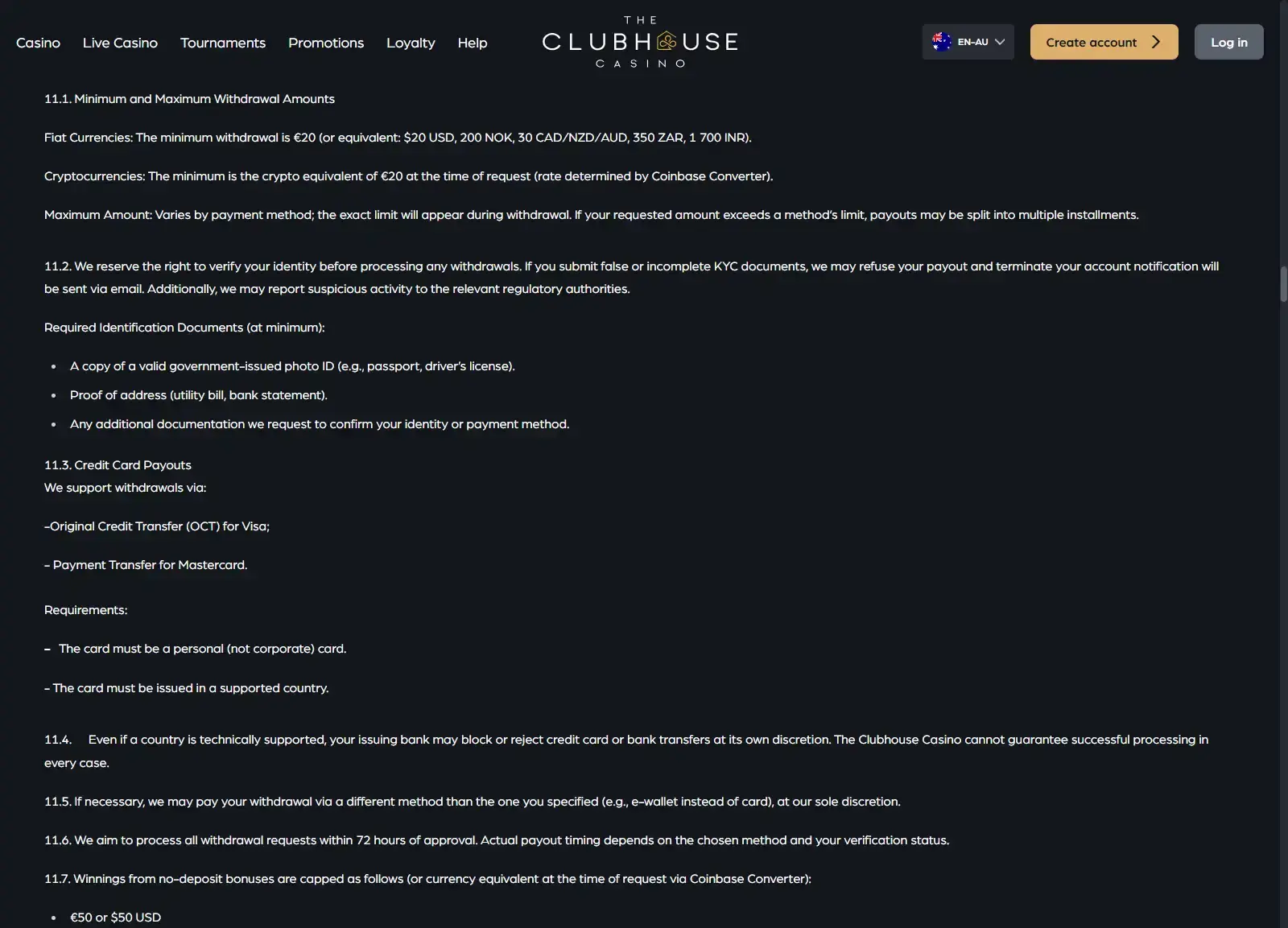
| Minimum fiat withdrawal | 30 AUD | This is the current Australian-dollar minimum stated in the AU terms. |
| Operator processing target | Within 72 hours after approval | This is not the same as final delivery to your bank, card or wallet. |
| Weekly frequency limit | EUR/USD 7,500 or equivalent | Do not silently convert this to AUD without a published AUD figure. |
| Monthly frequency limit | EUR/USD 15,000 or equivalent | The current terms state the base figure and an equivalent-currency rule. |
| Method maximum | Varies by payout method | The selected withdrawal route can impose its own transaction ceiling. |
The minimum is straightforward because the terms give an explicit 30 AUD value. The larger frequency limits need more care. They are expressed in euros and US dollars with an equivalent-currency clause, so an Australian review should preserve that wording rather than presenting a home-made AUD conversion that could move with exchange rates.
The method maximum is also separate from the weekly and monthly limits. If a payout method has a lower transaction ceiling, a larger approved withdrawal can be split into multiple instalments. That is one reason the amount you are allowed to withdraw over a week or month is not necessarily the amount a single card, wallet or bank transfer can carry in one transaction.
Withdrawal time is a chain, not one stopwatch
A useful way to read Clubhouse withdrawal timing is to divide the process into stages. First comes the withdrawal request itself. The account can then move into internal review, including KYC or payment-ownership checks when required. Approval comes after those checks. The casino’s published 72-hour target begins from approval, and the payment route then has its own transfer and settlement behaviour before funds reach you.
- Request: you choose an available payout method and submit the cashout.
- Review and verification: the casino can request identity or payment-method evidence before completing the withdrawal.
- Approval: the request clears the operator’s internal checks.
- Operator processing: the current terms state a target of within 72 hours after approval.
- Payment-network delivery: the card issuer, bank, e-wallet or other processor completes its part of the transfer.
This distinction matters because a review that advertises a single “withdrawal time” can collapse several different steps into one number. A request that needs additional verification can remain pending before approval, while an approved request can still take additional time to move through the selected payment network. The operator target and the final arrival time answer different questions.
The broader payments overview explains the casino’s card, e-wallet and crypto categories. This page stays focused on cashout rules, not on reproducing a long list of payment logos that can change by country or account.
KYC can pause a withdrawal before processing begins
The current AU terms state that withdrawal requests can remain pending until required verification is completed. They also list government-issued photo identification and proof of address among the core document categories and allow additional evidence to be requested when needed. That makes KYC part of the withdrawal timeline rather than a separate administrative issue.
The practical effect is simple: if the account has not completed a requested check, the 72-hour processing target should not be read as starting from the moment the withdrawal button is pressed. The terms tie that target to approval, and approval can follow verification. Preparing accurate account details and responding to document requests can therefore matter more than choosing the fastest-looking payment method.
This page deliberately does not repeat the full verification policy or its separate review-time wording. The dedicated KYC before withdrawal covers document categories, account checks and the verification process in detail.
Payment ownership and payout routing can change the path
The official terms require deposits to come from a payment account registered in the player’s own name. That ownership rule is relevant at withdrawal because the casino can check the relationship between the player, the funding method and the payout route. It is a strong reason not to treat someone else’s card, bank account or wallet as an interchangeable way to fund an account.
The terms also allow the casino to use a different withdrawal method from the one originally selected when necessary. Card payouts have additional conditions: supported personal cards are treated differently from corporate cards, and the issuing bank can still reject a transaction even when the casino supports the payout route. For card-funded accounts, the current terms also distinguish between returning funds up to the net card deposit and routing excess amounts through another available method.
Those rules are more useful than a blanket statement that every withdrawal returns to the original deposit method. The actual route can depend on the selected method, the amount, card support, account history and what the live cashier permits at the time. If your preferred payout route matters to you, check it before making the deposit rather than after a win.
Fees: separate casino charges from bank or processor charges
The AU payments page says the casino itself charges no payment fees, while warning that some transfers can attract charges from processing banks. The withdrawal terms separately say intermediary banks may impose charges and that players are responsible for fees applied by their bank or payment provider. The important distinction is between a casino-side fee and a third-party charge outside the casino’s control.
Because fees and method availability can change with the route, the safest check is the live cashier plus the information supplied by your bank, card issuer or wallet provider. Do not assume that a method labelled free on the casino side guarantees that every intermediary will also charge zero.
Why the live cashier can override a static review table
The Clubhouse payments page explicitly says payment methods are country-specific. The official terms also state that method maximums are displayed during withdrawal. Together, those rules make the account-level cashier more authoritative for a particular transaction than a copied review table.
Before submitting a withdrawal, confirm four things in the current account view: the method is actually offered for cashout, the transaction amount fits its current limits, the receiving account belongs to you where required, and there is no outstanding verification request. If a method is missing, do not assume that an old review or a public payment logo means it can still be selected.
The registration guide covers the account rules that sit upstream of this process. For the separate legal and regulatory context around an Australian user accessing an offshore casino, use the Australian regulation.
Before requesting a withdrawal
- Check that the balance is withdrawable under any active bonus or deposit wagering conditions.
- Confirm that the amount is at least the current 30 AUD fiat minimum.
- Check the method shown in the live cashier and its current transaction maximum.
- Make sure the payout account and your casino account details match where ownership checks apply.
- Complete any requested KYC before expecting the withdrawal to move to approval.
- Read the weekly and monthly limits as EUR/USD figures or equivalent unless the site publishes a current AUD value.
- Allow for the difference between operator processing and payment-provider delivery.
- Check whether your bank, card issuer or payment provider may impose its own charge or reject the transfer.
This checklist is designed to prevent the two most common reading errors: treating the 72-hour operator target as a guaranteed final arrival time, and treating a public payment-method list as a promise that the same route is available to every Australian account.
If you are still comparing the casino as a whole rather than solving a cashout question, return to the Clubhouse Australia review for the combined view of bonuses, games, payments, account checks and trust.
How the periodic limits and method limits work together
The weekly and monthly limits describe how much can be withdrawn across the relevant period, while a payment method can have its own per-transaction ceiling. Those are different controls. A payout route with a lower transaction maximum does not automatically reduce the published weekly or monthly allowance; instead, the terms allow a larger withdrawal to be divided into more than one instalment when the selected method cannot carry the whole amount at once.
That distinction is useful when planning a larger cashout. First check the remaining weekly and monthly allowance under the terms. Then check the maximum shown for the actual method in the live withdrawal screen. Finally, allow for verification and delivery stages. Treating those three checks separately is more accurate than searching for one universal “maximum withdrawal” number, because the answer depends on both the periodic rule and the payment rail.
Practical view of Clubhouse withdrawals
For Australian readers, the clearest current cashout facts are the 30 AUD fiat minimum, the operator’s target of processing within 72 hours after approval, and the weekly and monthly limits of EUR/USD 7,500 and EUR/USD 15,000 or equivalent. Those figures answer different parts of the withdrawal question and should not be collapsed into a single “instant payout” claim.
KYC can keep a request pending before approval, payment methods are country-specific, and the final route can be affected by card rules, alternative payout routing and third-party processing. Check the current cashier before submitting the request, then judge timing as a sequence from review to approval to operator processing to final payment-network delivery.